Sharmin: I want to learn. Please accept me.
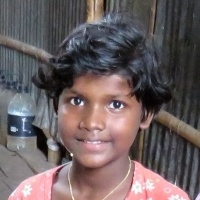
One day, ten-year-old Sharmin came to the Chalantika Education Centre in Dhaka on her own. She stopped at the door, watched what was happening inside for a moment, and then took a step forward. She crossed the threshold and said to the teacher: “I want to learn. Please accept me.”
A tin shack filled with fear and uncertainty
Sharmin is growing up in the densely populated Chalantika slum in Dhaka. Her home is a small tin shack among rows of others, separated by narrow wooden walkways. The entire settlement stands on bamboo structures above a swamp filled with waste.
Inside, there is just one room. A simple wooden bed, clothes hanging on lines, a few pots, and basic cooking utensils. Five people live in this small space.
When it rains, the rattling tin roof drowns out any conversation inside. And during the summer, when temperatures rise above 40°C, the hot metal roof heats the air inside until it becomes almost unbearable, not to mention the smell rising from the sewage below.
There is also constant tension at home. Sharmin’s father struggles with addiction and has been using drugs for a long time. He does not work and does not contribute to supporting the family. Sometimes he is quiet and withdrawn, as if he were not there at all. At other times, he becomes aggressive and the children fall silent. Shouting, insults, beatings and tears. When he cannot get drugs, he suffers from health problems. For the children, this means living in an environment that is neither predictable nor safe.
The burden of supporting the family rests on Sharmin’s mother, Kajol. She works as a domestic helper in five households. She leaves early in the morning and returns in the afternoon. Her monthly income of 8,000 taka is painfully low. Half goes towards rent, a quarter towards her son’s schooling, leaving just 2,000 taka for food and basic necessities. That is around €0.10 per person per day. Food is not guaranteed.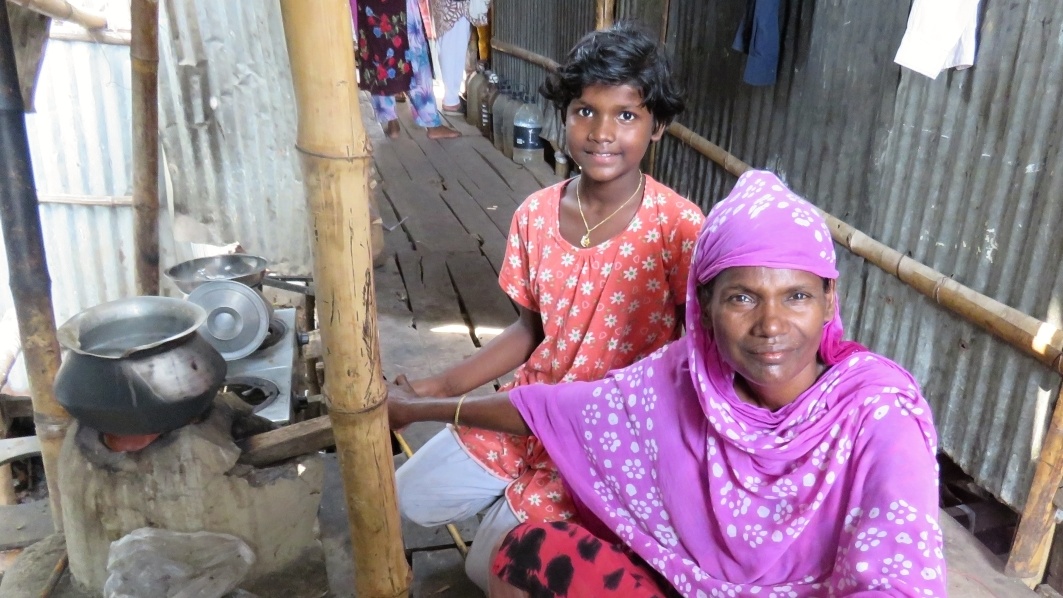
The courage to ask for a place in the classroom
Sharmin grew up in an environment where children often do not get the opportunity to go to school. Yet at the age of ten, she decided to take action. She found her way to the Chalantika Education Centre on her own and asked for a chance to study, saying: “I want to learn. Please accept me.”
The centre’s team visited her home to assess her situation firsthand. They saw the conditions in which the family lived, as well as the difficult family environment. Sharmin met all the criteria for admission, but at the time, the centre was full. She was therefore placed on a waiting list.
Life at home continued unchanged. But one thing had changed – Sharmin knew there was hope. And when a place became available, she was admitted.
Today, she is in Year 2 and regularly attends the education centre. She has a structured daily routine, access to education and regular meals, and spends time in a safe environment with other children.
For her mother, this makes a world of difference. “I used to worry about what would happen to the children when I came home. My husband is unpredictable. But now I know that Sharmin is safe,” she says.
Sharmin is clear about her future: “I want to become a teacher. I want to help children like me.”
Give safety and food to more children
Sharmin’s story is not unique. Many children grow up in environments where food is uncertain, adults spend all day working away from home, and home is not always a safe place.
Sharmin was given a chance because she came to the centre’s door and found the courage to express her desire to learn. Many other children cannot take that step on their own. But that shouldn’t stop us from reaching them.
Your support can provide them with food, safety and education. Thanks to you, they too can one day say: “I want to learn.” Help children from the Chalantika slum open the door to a new life.
Thank you!